
Talent Talk: Steven Chevallier
Steven Chevallier is a knitwear designer and painter whose work explores queer identity, marginalisation, and the power of challenging social norms. Combining deadstock yarns, felted wool, and experimental knitwear techniques, Steven brings together traditional craftsmanship and material exploration. His work challenges perceptions of difference, transforming symbols of ridicule into expressions of resistance, identity, and self-expression.
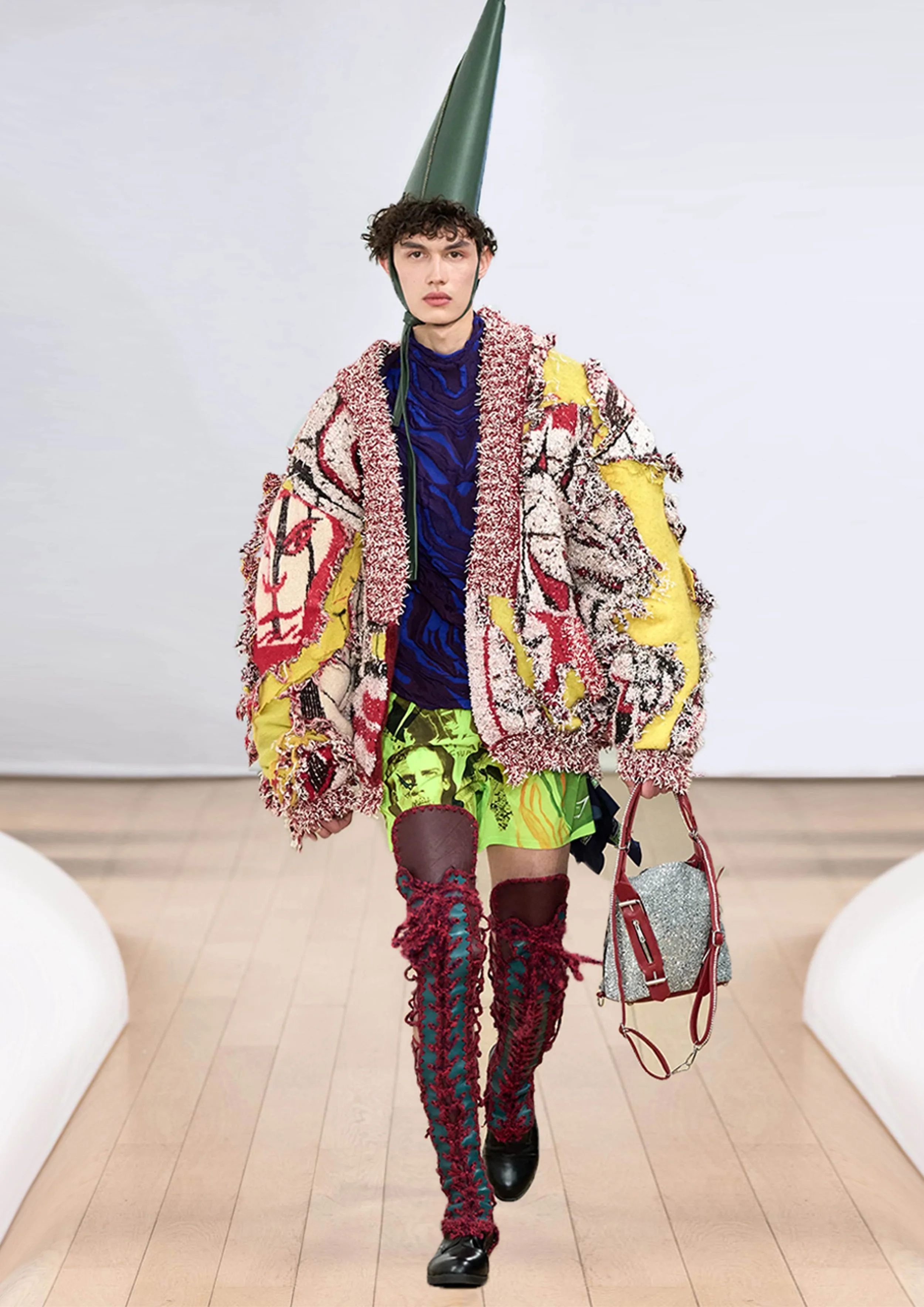
Photo by Vogue Runway
Could you please introduce yourself?
My name is Steven Chevallier. I’m a knitwear designer and a painter. I’m a very graphic person. I love colors and playing with textures. I’m also very inspired by society and history. Through my artwork, I try to make people question themselves and reflect on topics such as society, identity, and freedom. I’m a very visual and graphic person, and painting is a form of therapy for me. It is always the starting point of my textile work. I love playing with textures and materials, which is why knitwear and textile design are my specialties. I enjoy translating my drawings and paintings into knitwear, using techniques such as jacquard, embroidery, and punch needle felting.
Having graduated recently, how do you look back on your studies?
When I look back at my studies, I feel very happy and lucky. I first studied at Central Saint Martins in London, and for me, that is where I really developed my creativity and my visual language, particularly through colour and texture. London is also a very multicultural city, with people from all over the world living together. I was very inspired by the way people dressed in the streets, and it really opened my mind and broadened my perspective. For my Master’s degree, I studied in Paris at IFM, the Institut Français de la Mode. There, I was really able to develop my skills in knitwear design, particularly by working with industrial Stoll knitting machines. I also think I was more mature in my approach to my work, which allowed me to combine my creativity with technical skills and create a collection that was more refined and developed than the one I had produced during my bachelor’s degree. In terms of creativity and research, I also felt that my vision of fashion had become more mature. My work had a stronger sense of purpose, and I think my messages became more political and meaningful.
Could you please tell us something about your graduation collection/project?
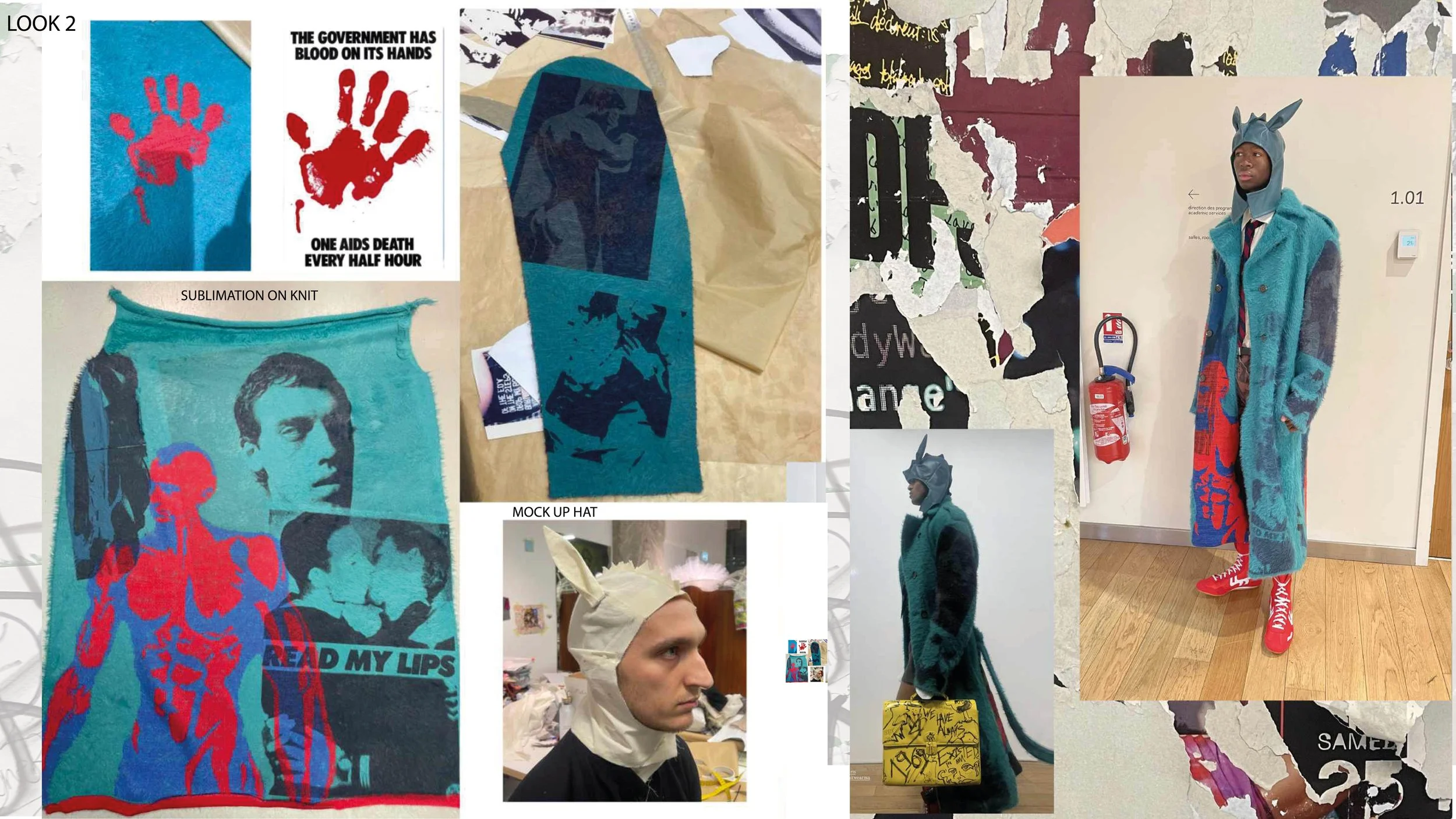
My collection explores the historical persecution of the queer community by conservative movements, focusing on curent events and historical as the 1980s HIV crisis, the Stonewall riots, and the work of queer militant as Derek Jarman et David Wojnarowicz. The 80’s HIV crisis particularly stood out, with its stigma fueled by media and medical narratives linking the disease to queer community, worsening discrimination. I want to honor and celebrate those who have fought and continue to fight for our rights. Regarding the difficult social climates, I believe that we have always existed, will continue to fight, and will always be stronger and proud of who we are as a community.
Which materials, techniques, programmes and/or applications are you mostly interested in?
I mostly start to draw or print first and than I am very textile-focused, and my creative process is closely connected to textile manipulation. For my knitwear, I explored a contrast between industrial and artisanal techniques, combining an industrial knitting machine with punch needle, embroidery and felting. I mainly worked with dead-stock mohair and wool sourced from IFM and yarn companies, as well as leather from Hermès and faux fur from Ecopel in Paris.
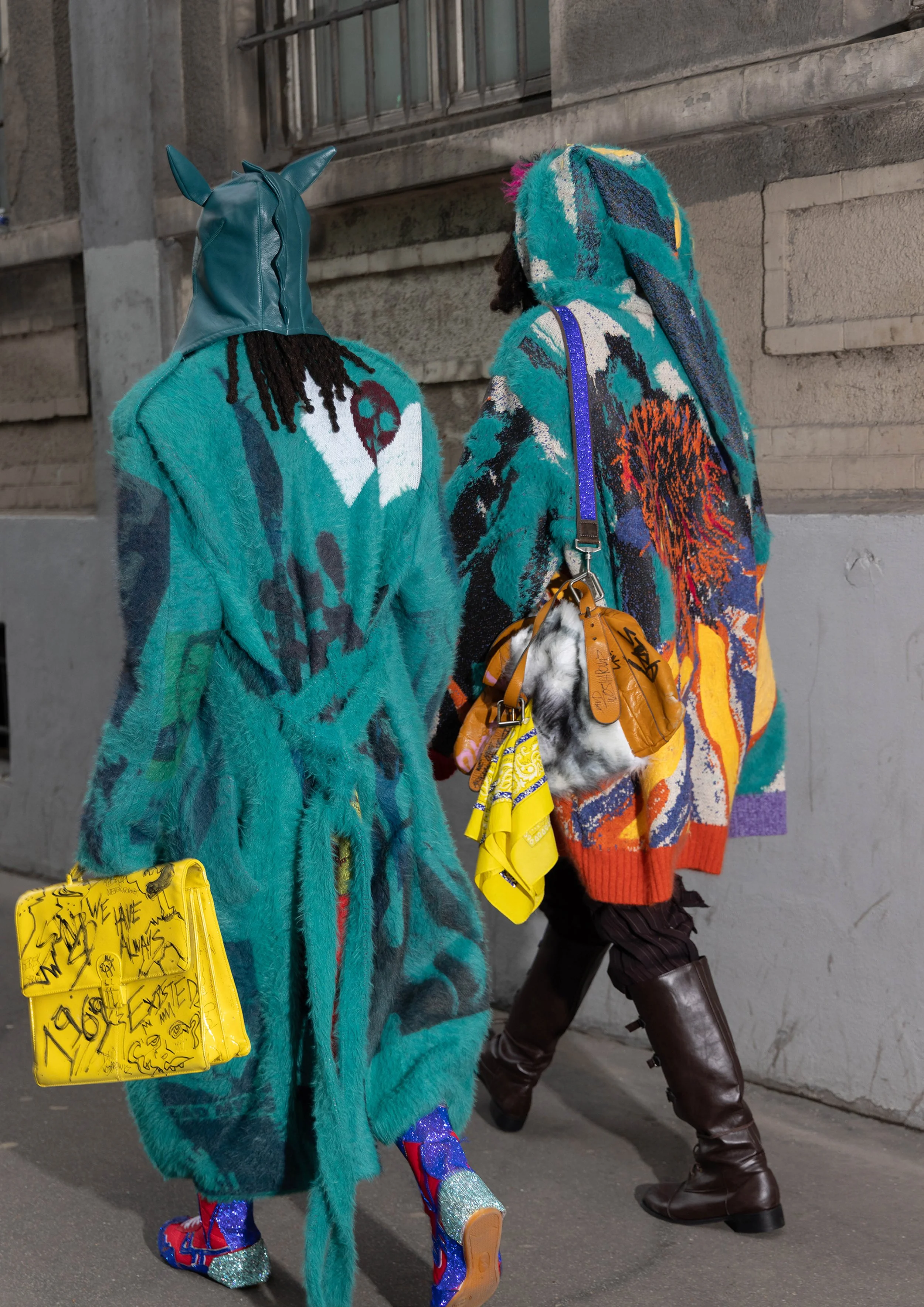
Photography by Shubie Goswamy
The exhibition you are a part of looks into the connect between animals, people, and place (flock, folk, field). What does this mean to you and how do you see it refelcted in your work?
As a young designer, I strongly believe in the importance of sustainability. The fashion industry has a significant impact on both the planet and society, and I believe we already have more than enough clothing in circulation. My work therefore focuses on giving new life to existing materials while exploring our relationship with animals, craft and nature.
Animal references are an important part of my research. My hats, featuring animal ears, are inspired by medieval jesters. Historically, these accessories were associated with people considered “mad” or outside social norms. I reinterpret this symbolism through a contemporary queer perspective, using the hats as a metaphor for communities that have been marginalized, misunderstood or ridiculed.
Finally, I experimented with felting using wool from independent farms in France. This allowed me to connect the garment to its raw material, the animal and the landscape, while exploring how traditional craft techniques can be reinterpreted through contemporary knitwear.
How do you perceive the meaning and importance of community within the fashion field?
For me, the importance of community in fashion is very significant. This is particularly true because I am currently creating my own label as a young independent brand. I feel very close to my friends who are also building their own independent brands, and there is a lot of support between us. We give each other advice and motivate one another, because the fashion industry is a difficult one, especially when you are competing with large groups that have enormous amounts of money and resources. When you launch a project or a brand with limited resources and a small team, it is not easy, and that is why community is so important. More broadly, I also think that, as I was saying, my approach is quite political. I believe that we need to support one another across all communities, particularly because I work a lot around queer communities and the people who fought for us, and who continue to fight against conservative movement.
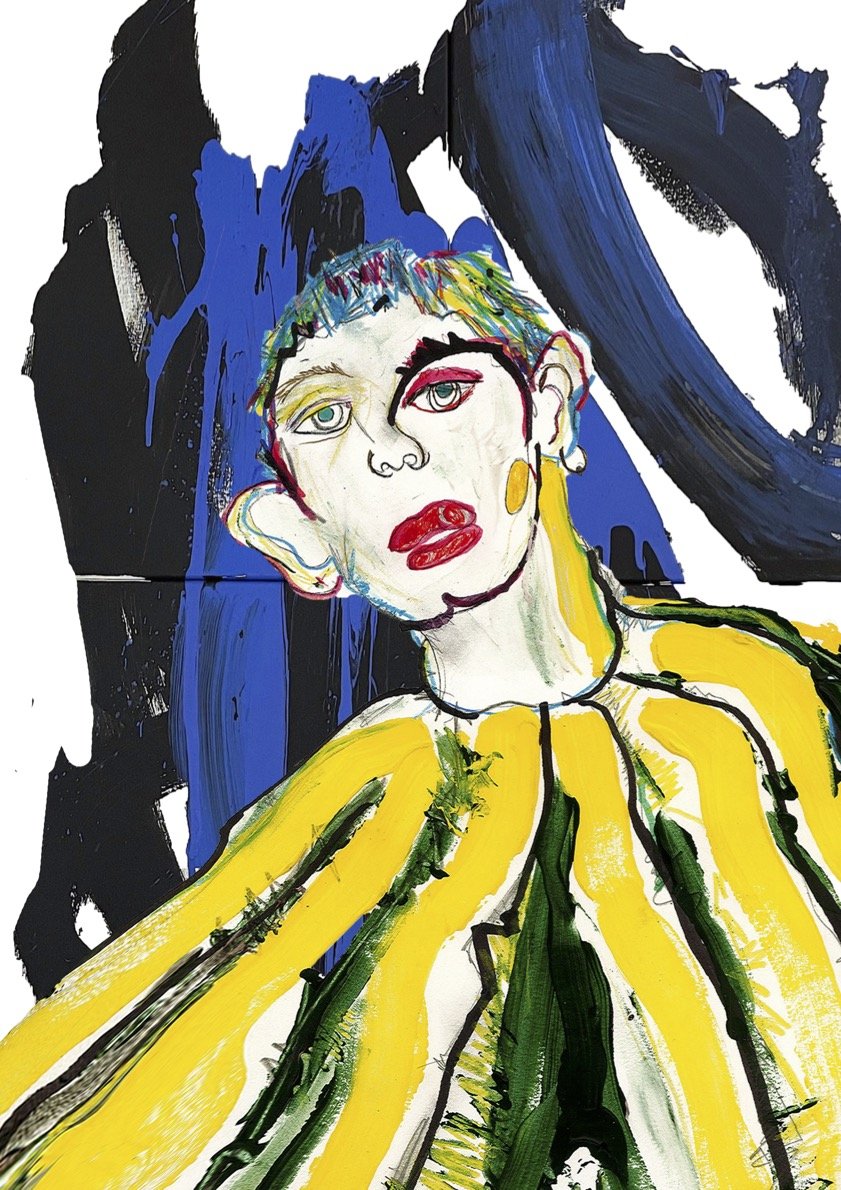
Painting by Steven Chevallier
How do you view the future of fashion? And your own role therein?
When I think about the future of fashion, I remain, of course, positive, and I try to look at things from the bright side. When I see the growing number of designers who are becoming more independent and who have stronger ethical positions regarding ecology, climate, and politics, I think there are some really beautiful things that can be created. Personally, I want to try to do things as well as possible: to create clothes that have a social meaning, environmentally, and creatively and to produce high-quality pieces and work with teams who share the same values as I do.