
Talent Talk: Jian Da Huang
Jian Da Huang is a designer based in the Netherlands whose practice explores the stories, identities, and power structures woven into textile traditions. In Unwoven Heritage, Huang brings Dutch Gansey knitting into dialogue with Ghanaian motifs and Vlisco fabrics, reimagining how craft knowledge travels across cultures and histories. Through deconstruction and reknitting, Huang imagines alternative histories, asking whose stories survive through making and what new connections might emerge when traditions meet.
Could you please introduce yourself?
I am Jian Da Huang, a designer and researcher from Taiwan, based in Eindhoven. I work with one method across different materials: I start from an archival fragment, imagine the history it could have had, and build that history as an object. The result may be a textile, a meal, an object or a gathering, depending on what the question needs. What they share is that each uses a fictional past to look at a present issue, such as who owns a tradition, who gets to belong, or what brings people together. I am also the founder of NOR, a food design and arts venue at Strijp-S.
Could you please tell us something about your project?
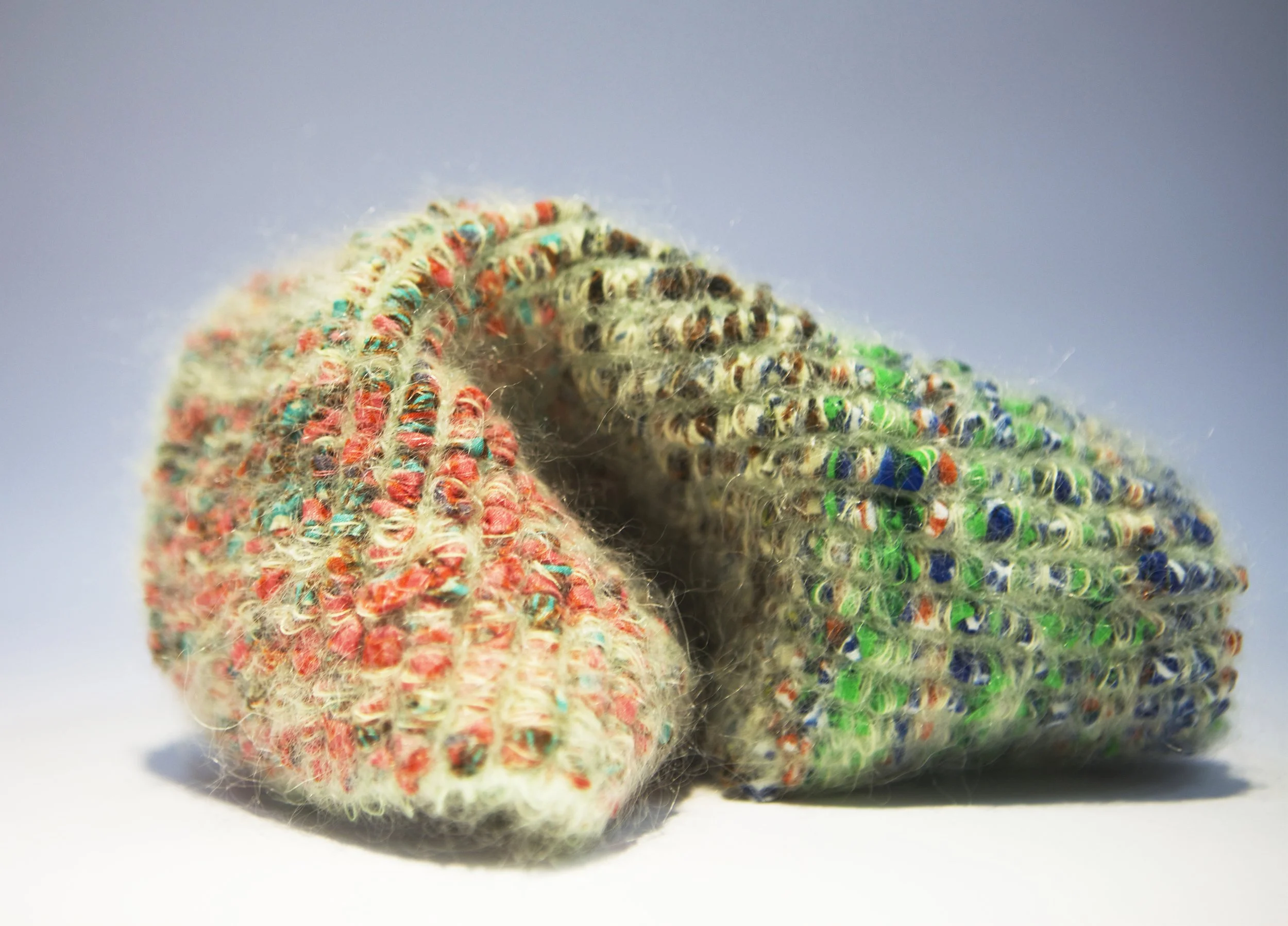
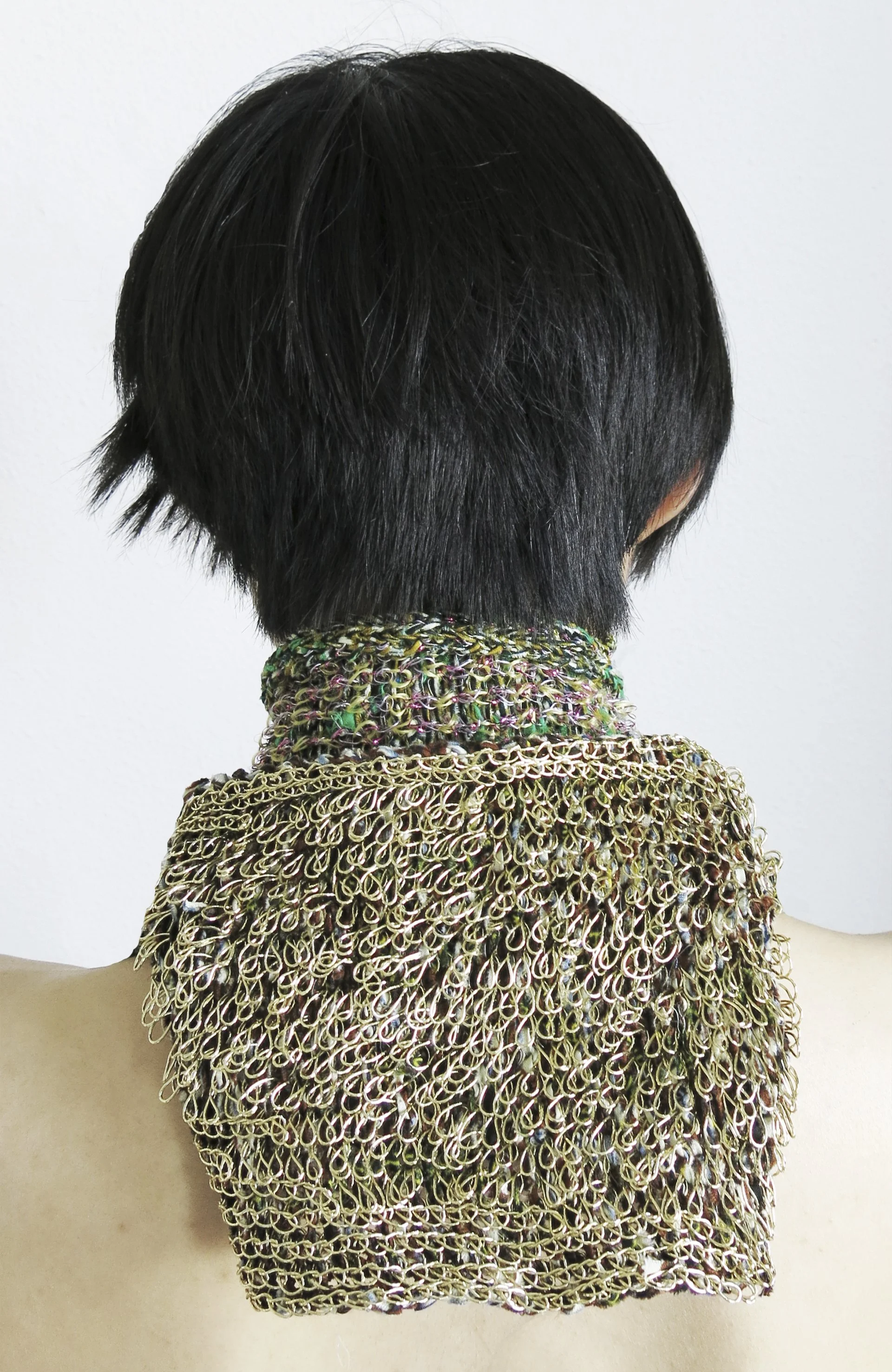
Unwoven Heritage is a wearable sculpture and material bank made from deconstructed Vlisco wax print fabric. Vlisco was industrialised in the Netherlands from Indonesian batik techniques, redirected to West Africa, and over time absorbed there to the point of being read as indigenous.
The starting point was a 1915 Basel Mission archive photograph of schoolgirls in Cameroon knitting socks for German colonial soldiers. A European domestic craft was introduced into a context it had no prior relation to. That raised my central question: what happens when a technique arrives before it has found its own use, and what could it have become if the knitters had directed it toward their own trade and identity?
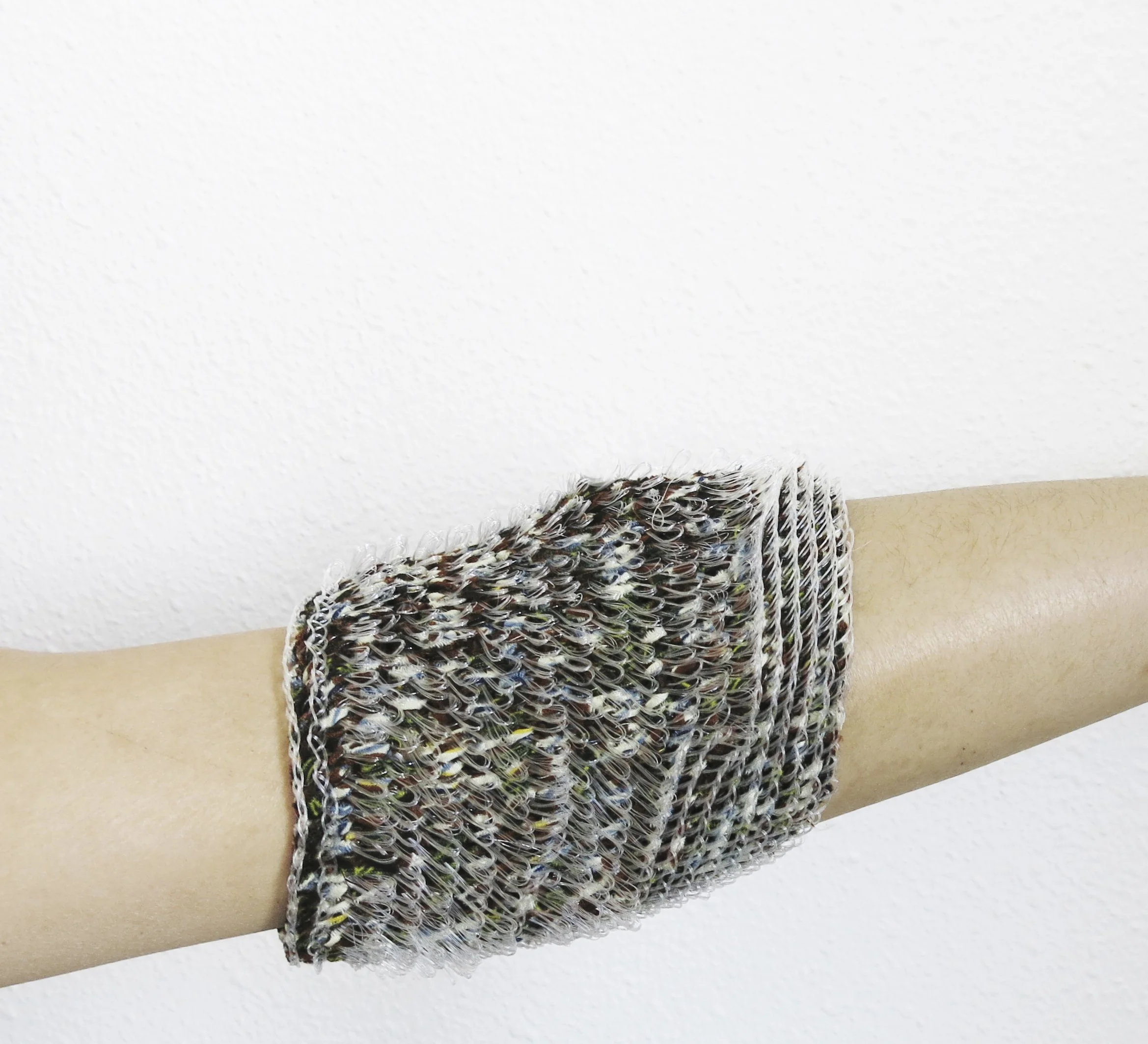
The project itself is a material study. I took Vlisco fabric apart, reclaimed its cotton yarn, and developed it into knitted structures. I try to let each section of the piece correspond to a different speculative historical narrative. The project is supported by Het Cultuurfonds.
How was it working in the Lab at New Order of Fashion, and did you also work in other maker spaces?
At the NOOF Lab I did the deconstruction work: turning Vlisco fabric back into yarn and strips that can be knitted again. I mainly used the HILO spinning machine, spinning the deconstructed fabric together with wool into new yarn. Working in the Lab meant I could operate the machine myself and work in small quantities, so I could directly control the ratio of fabric to wool and the thickness of the yarn. This stage is slow and repetitive, and having a place to test and fail at small scale was necessary before moving to production.
The machine knitting was developed at TextielLab in Tilburg, where I worked with technician Yani Chuang over eight days to turn cotton, wool, nylon and Vlisco strips into knitted textiles. I also collaborate with knitwear specialist Hsiang Lin Kuo of STUDIO SHOON, who develops the reclaimed yarn into knit structures.
Which materials, techniques, programmes and/or applications are you mostly interested in?
I am most interested in materials and techniques that carry layered meanings. Knitting was introduced to West Africa by Europeans, just as Vlisco was. In this project I put the two together: I unravel the fabric, respin it and reknit it, and imagine how such a textile might have evolved if the technique had stayed in the knitters' hands. In that way the making itself reconstructs the story.
What makes this material so complex and interesting to me is not the cloth itself but what people did with it. Its meaning was never fixed by the manufacturer alone. It was shaped by how designers, communities and individual wearers responded to an object and a technique they were given, and by the possibilities they found in it. That process worked in both directions: in reshaping the material, they also redesigned their own identity. The knitted Vlisco textile that never existed shows this again: what colonial history leaves behind in a technique or a material is not simply good or bad. Through what people create and design with it, it can be given new meanings and new narratives. That gives us a way to look again at this complex material today.

The exhibition looks into the connection between animals, people, and place (flock, folk, field). What does this mean to you and how do you see it reflected in your work?
Flock, folk and field are often read as a line of origin: this animal, these people, this land. The material I work with does not have one. Vlisco began as Indonesian batik, was industrialised in the Netherlands and became part of West African identity. So for me the three words are less about where a textile is rooted and more about how the connection between animals, people and place is made, and remade, by those who use it.
How do you perceive the meaning and importance of community within the field of design?
In practice, community is what made this project possible. I could not have done it alone. The yarn was spun at the NOOF Lab, the knitting was developed with Yani Chuang at TextielLab and with Hsiang Lin Kuo at STUDIO SHOON, and each of them brought knowledge I do not have. A design like this is the result of several people's skills meeting in one object.
I also think community is where a design is completed. A designer can propose an object, but what it becomes is decided by the people who live with it. That is what the history of Vlisco shows me.
What are you doing now, and where do textiles and contextualising them echo in your work?
I am running NOR, which opened in July and hosts its own programme during Dutch Design Week. I recently received the Talent Development grant from Stimuleringsfonds Creatieve Industrie. In the coming period my research will focus on the role of food and how it generates community. Alongside this, I am planning the next phase of the textile project with Hsiang Lin Kuo, developing the reclaimed yarn into full-scale wearable pieces.
Textiles taught me to read a material through its route. A cloth and a dish behave in a similar way: both travel, get adopted, and are later claimed as someone's own. With Vlisco I looked at how people gave meaning to a material. With food I want to look at the next step, which is how a shared material brings people together in the first place.