
Talent Talk: Ruusa Vuori
Trained as a dancer, Aalto graduate Ruusa Vuori found her way into fashion after an injury opened a new path for her creativity. In Second Skin, she explores wool as a form of borrowed protection, revealing the delicate balance between vulnerability and comfort through a wondrous interplay of texture, craft, and the body.
Hi Ruusa, welcome back! We spoken with you three years ago, and are happy to chat again. Could you please re-introduce yourself?
My name is Ruusa Vuori and I’m a Helsinki based artist and designer. I’m studying fashion design at Aalto University where I did my Ba Graduate Collection back in 2023.
My practice delves into embodied knowledge and focuses on sensory experiences and somatic memories. I work primarily with weaving while also exploring other techniques and mediums. I have worked with materials such as flax grown by my great-grandmother, wool, human hair, natural latex, wood, wax, gift ribbon and other found materials.
I work with traces and memories imprinted on the skin.
What are some projects that you have been recently working on?
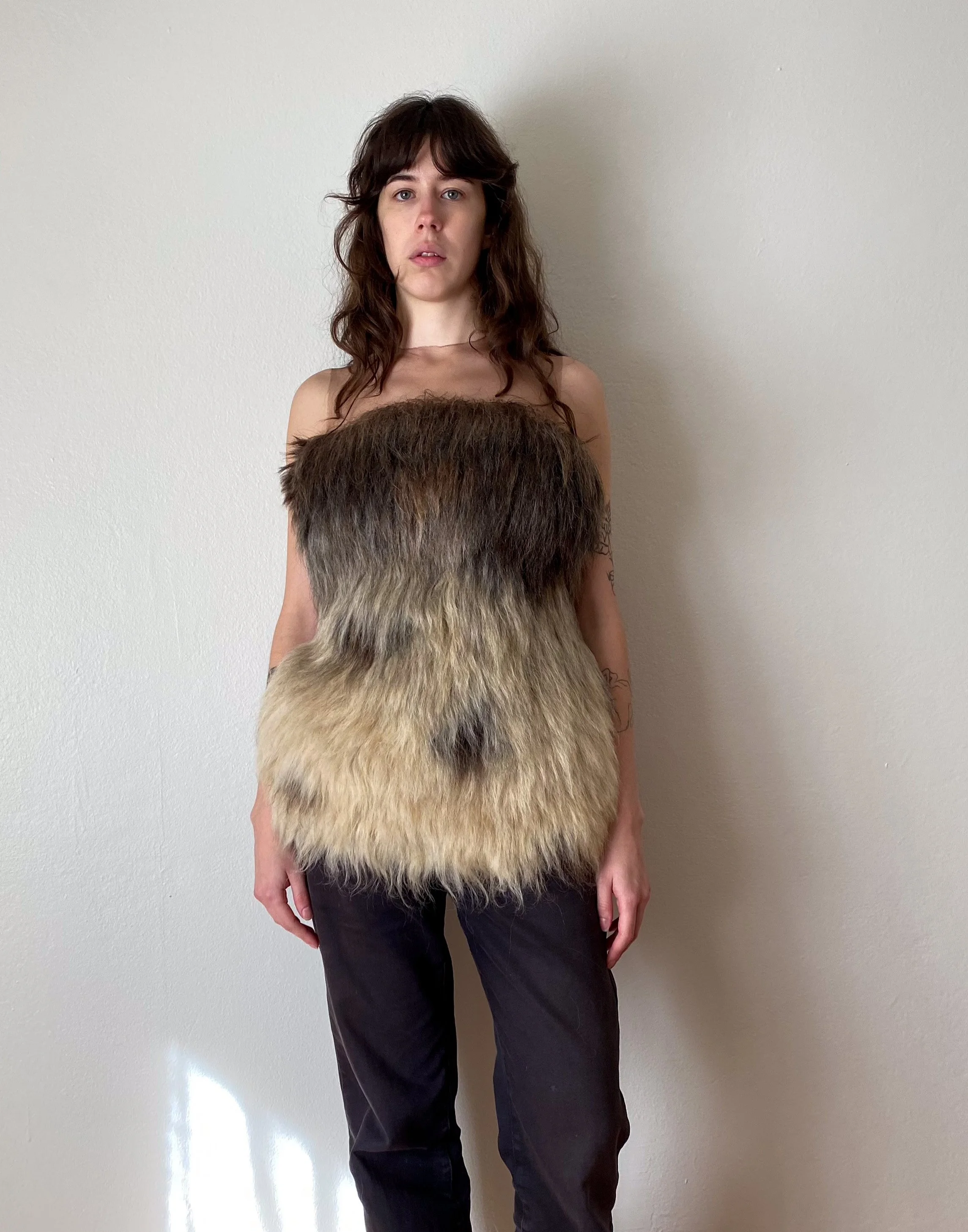
The latest project has been the woolen top or a minidress Second Skin that is currently exhibited in the Flock, Folk, Field exhibition. It is the fruit of my summer residency at New Order of Fashion.
Last fall I was lucky to be a part of the a20 salonkinäytös fashion show that presented the work of 20 designers at Helsinki Design Week’s 20th Anniversary. It was organized by Fashion Community Helsinki and Alex Luonto. It was a great and unique opportunity to work and showcase my work alongside the community.
For the a20 fashion show I created a look from linen yarns I got from my mother’s friend’s spouse’s grandmother Eeva. Thank you Eeva! I wanted to highlight the beautiful material and play with it. I dipped the ends of the yarn in beeswax and stearin to create different color shades and give the yarn a certain texture and feel. The top is woven on a cotton warp using a traditional Finnish Ryijy (Rya Knot) technique, also known as long pile weaving.
This was my first time putting up a loom and making my own warp. Luckily I got help and guidance from my dear friend and colleague Selma, and learned a lot.
The final look is called Solace. It consists of a woven linen rya (ryijy) top with one arm hole and a natural latex mini skirt and shoes.
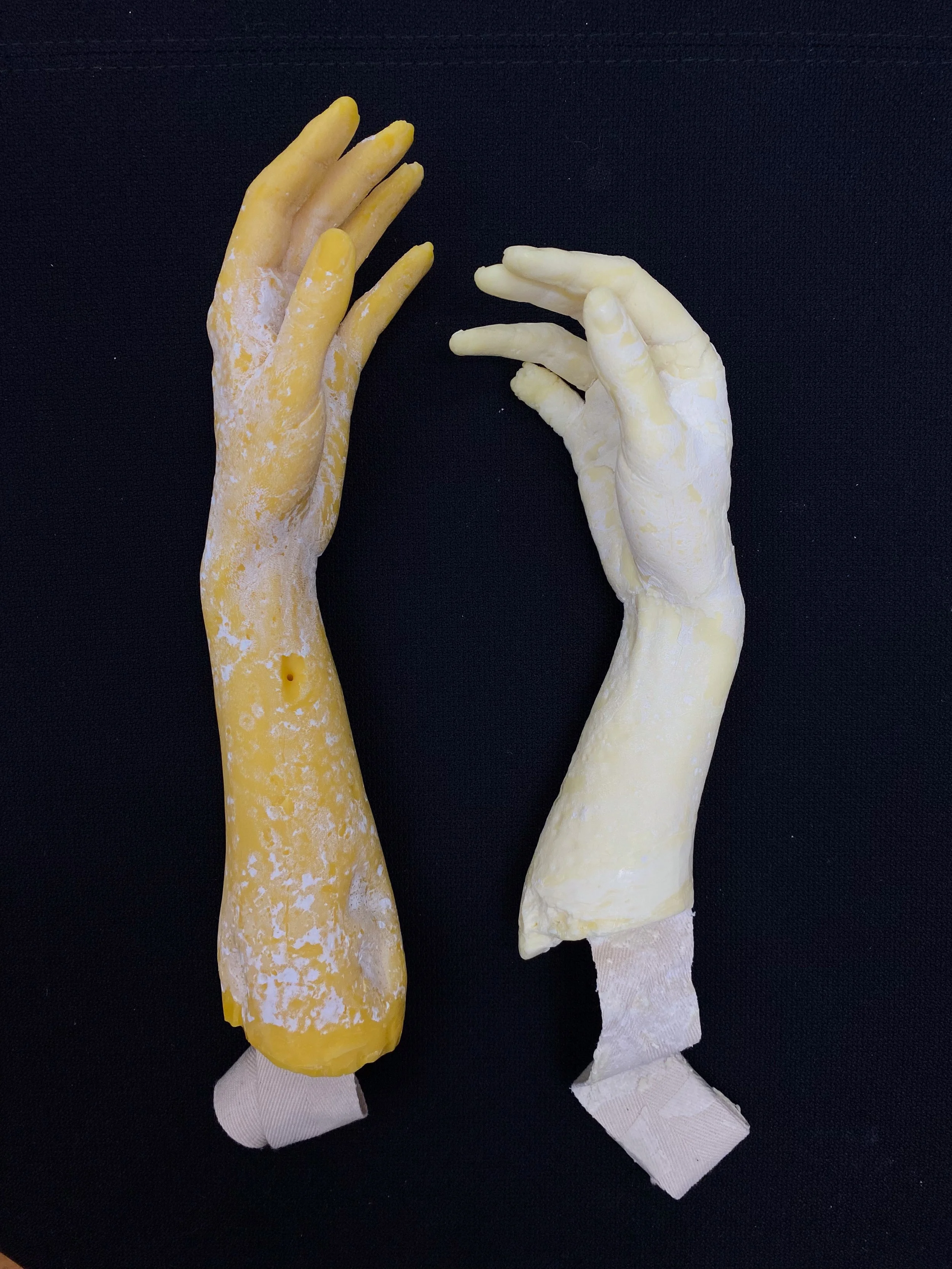
This summer Solace was exhibited alongside my other works at an exhibition called Tomorrow’s Wardrobe in Oulu Art Museum. For the exhibition I created hands out of beeswax, as the positioning of the hands is essential to the work. I made the hands by casting. The process was super fun and something I hope to work with again.
Earlier this year, we founded our collective Pienkutomo, with Selma Mataich and Victoria Torboli. We are three textile artists working with weaving alongside other techniques and mediums, and we share a working studio. We plan to organize weaving workshops for anyone who finds it difficult to access the tacit knowledge surrounding the practice of weaving.
I’m currently working on my first costume designs. It is a very exciting project with a great team of creatives. It is a multidisciplinary performance piece combining sound, tactile qualities, and experimental instrument making. You can see the final performances in October 2027.
I’m also making the costume designs for an upcoming contemporary dance piece in the spring of 2027.
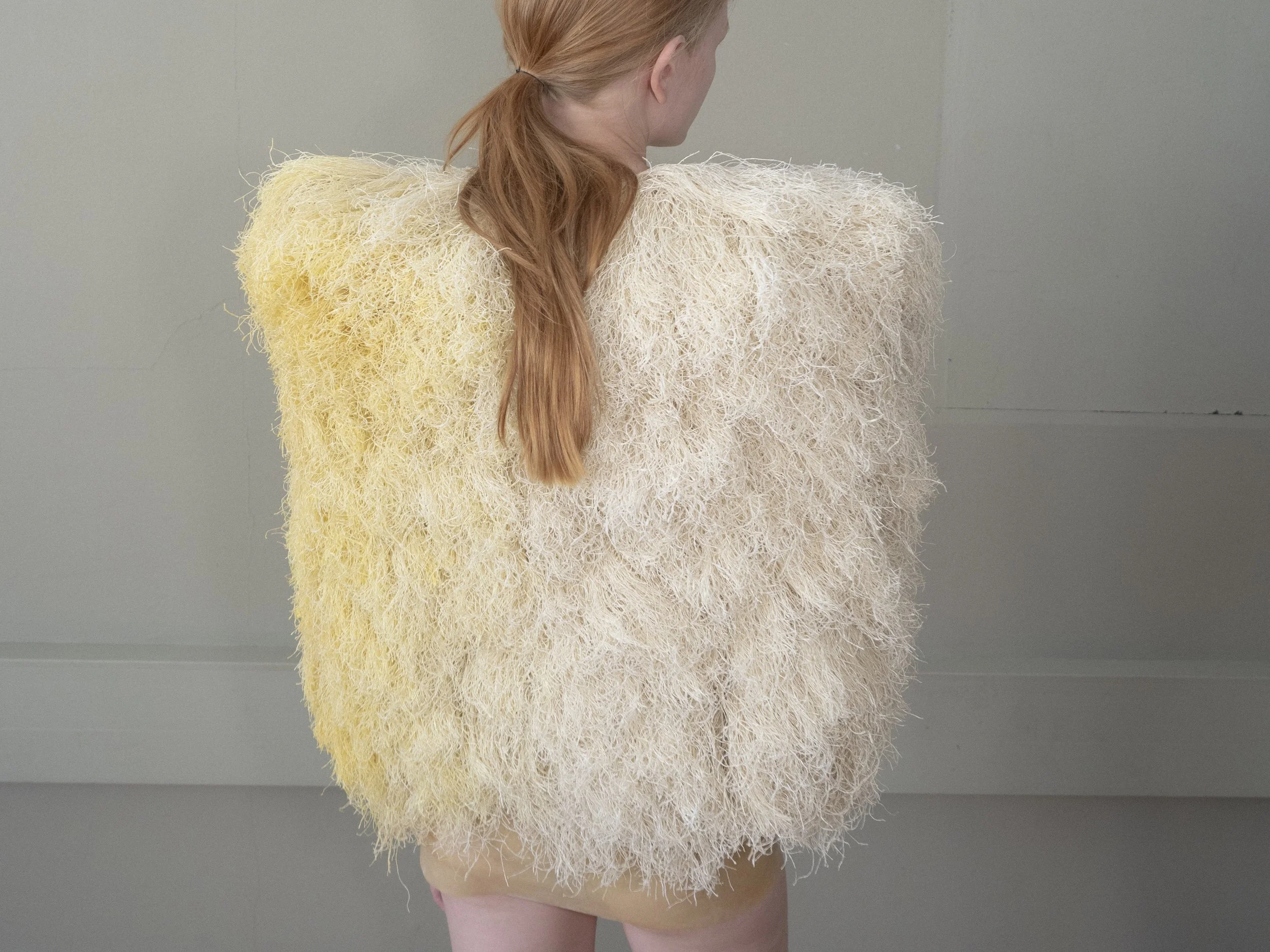
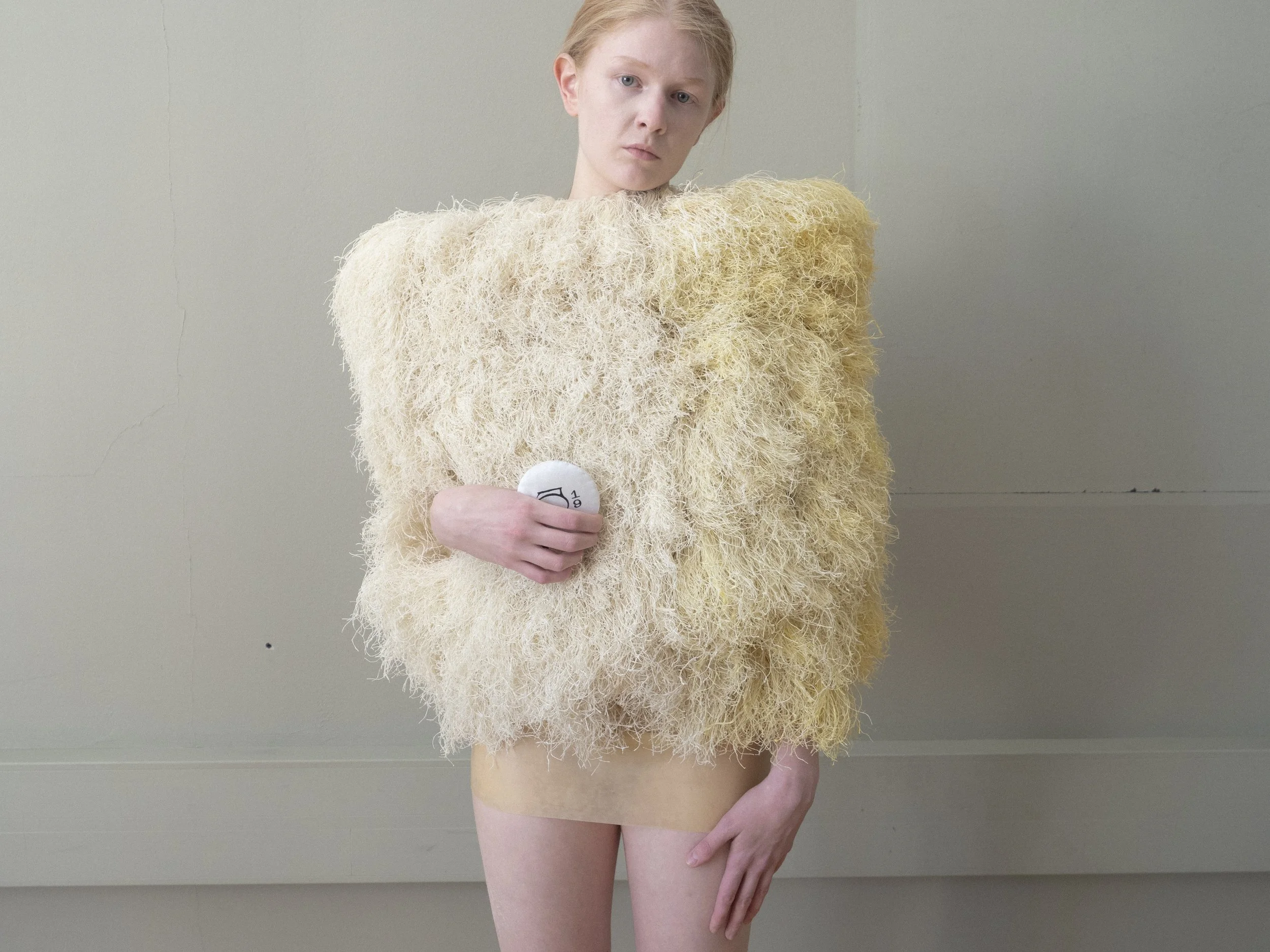
Photography by Juuli Kangasniemi
Could you please tell us something about your summer resedency with us?
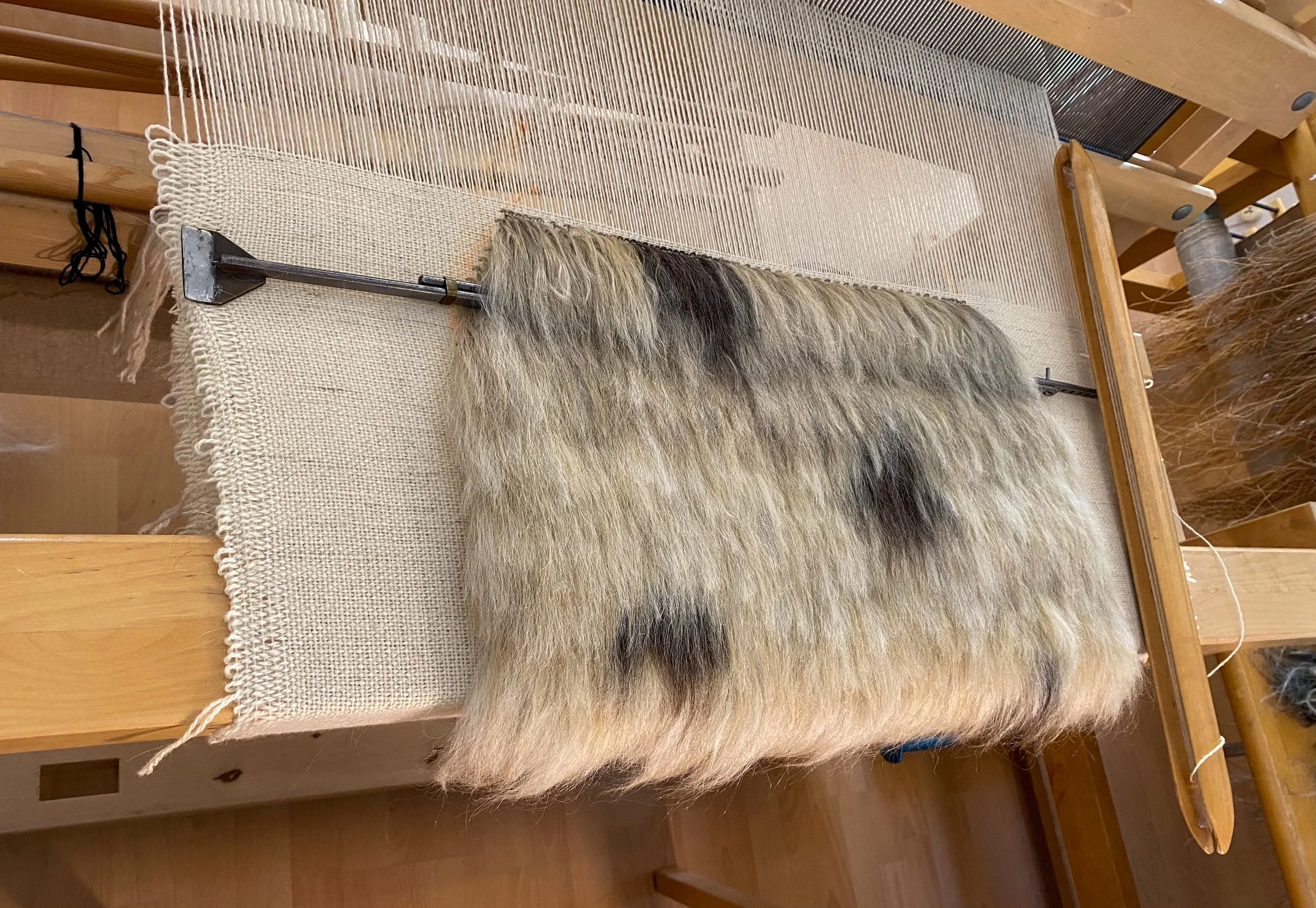
New Order of Fashion invited me to Eindhoven for a residency to explore how coarse wool could be applied in fashion. During the week-long residency, I focused on weaving on looms using a traditional Finnish Ryijy (Rya Knot) technique, also known as long pile weaving.
NOOF provided the wool of a Kempisch Heideschaap. I got to FaceTime with Pollyanna on the day of the shearing. There was a beautiful variety of shades and curls. This was my first time working with wool yet I was surprised how familiar and how alive the material felt. It reminded me of hair, especially pubic hair. The first samples that I made felt very intimate and at the same time comic. It was different from anything I had worked with.
During my stay I got to freely explore and create with the guidance from the lovely people at NOOF. I learned how to use the Dobby loom they have at the studio which is very different compared to what I’m used to.
I got to meet Savine Schoorl, a textile designer and material researcher who opened her studio doors for me to work in for a few days. This allowed me to work on a bigger loom and to make multiple samples. Savine was so welcoming and helpful. She sheared her knowledge and opened my eyes for all the possibilities.
Traveling to another country to create was very refreshing. It gave me time and space to sink in and at the same time to be more open to new perspectives. It was a great experience and I really enjoyed my stay.
After the residency I left with a suitcase full of samples, coarse wool, and wool yarns and got to continue my work back at home.
Which materials, techniques, programmes and/or applications are you mostly interested in at the moment?
I’m currently interested in materials such as wax, horsehair, hemp, sand, water, and air and I would love to continue working with coarse wool. I’m often drawn to things that are translucent and fuzzy.
At the moment, I’m mostly interested in weaving, especially ryijy (traditional Finnish knotted rugs) and tapestry weaving. I’m keen on finding anything but yarn for the ryijy as the technique allows playful experimentation and the use of unconventional materials. I’m hoping to deepen my knowledge and to expand my understanding of the possibilities of weaving.
While making the woolen look for the exhibition, I got into the wig making technique and I would love to explore that more, maybe in the context of textile art or sculpture.
At the same time I’m very much looking forward to working with more wearable stuff and even with readymade garments for the costume design projects. I think this is something that can give me new perspectives.
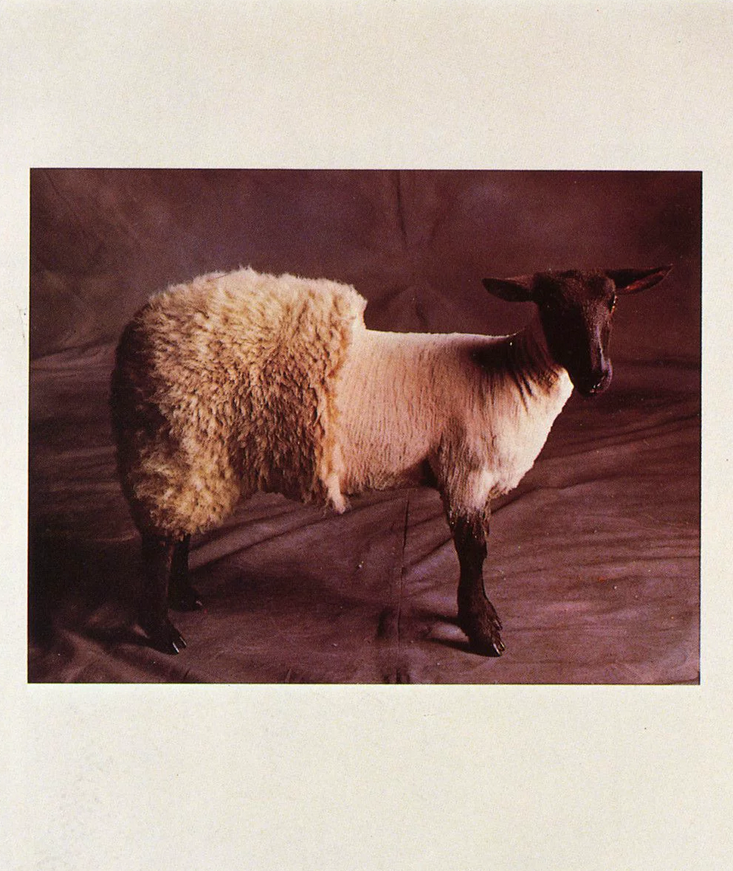
S.D. Warren, Lustro Dull Cream, (1985),
Source: AIGA Design Archives
Photographer: Unknown
The exhibition you are a part of looks into the connect between animals, people, and place (flock, folk, field). What does this mean to you and how do you see it reflected in your work?
I was fascinated by the idea of wool as “second skin”, as wearable protection that ultimately remains only something borrowed. I imagined the sheep’s experience of being shorn and exposed, left naked.
While researching coarse wool and the process of shearing, I came across images of sheep that had been only partially shorn: their front bodies bare, while their rear bodies remained covered in thick, fluffy wool. I became interested in this moment of partial transformation that might be a confusing state of in-betweenness for the sheep. The animal revealed beneath a voluminous fur suddenly appears small and fragile. The contours of the body contract, and the surrounding space radiates emptiness. I recognized that liminal state and the body seeking its limits.
I imagine a sense of relief as the weight and warmth of the wool are gradually taken away, and another state of being emerges. Perhaps it is also a moment of heightened sensitivity, when the body encounters the world again, and all the senses begin to awaken.
I started thinking about the shifting distribution of weight and how some parts of the body are still held in the warmth of the wool, while others are exposed to the wind. What does the grass feel like against a freshly shorn body or in my case against a naked body? What does touch become when there is no longer a layer of wool between the body and the outside world?
This reminded me of dressing up and getting undressed. I am fascinated by clothing as a kind of facade, an image presented to the gaze behind which one can hide. What happens when part of the body is revealed, left unhidden? When the act of concealment remains unfinished or is forgotten, and something is inadvertently revealed? In my mind, undressing parallels to this liminal process of shearing, in which the shielded becomes exposed, and the clothed becomes naked. What happens at that moment, when one has detached oneself from the old but has not yet entered the new?
The back of the look called Second Skin is almost entirely bare, as I wanted to create the illusion of a body that is simultaneously clothed and naked. In my work I always leave something uncovered. Through garments the internal can stay hidden from view yet it becomes visible to oneself.
What intrigued me about coarse wool was the life already lived within it. I think the connection between humans and animals is rooted in empathy. By wearing the wool of a non-human animal - can I come to understand something of the experience of the body that once inhabited it?
Last time we spoke, you reflected that you didn’t know yet what your own role or future was within the fashion field. How has this developed since we last spoke?
Maybe what has changed is how I relate to the idea and pressure of having to ”know” and define my own role and future in a particular context. I feel like the range of projects, people, and contexts I’ve worked with over the past three years has given me the freedom of defining my role on a project-by-project basis.