
Talent Talk: Minerva Skyttä
Minerva Skyttä is a Finnish fashion and textile designer that makes experimental knitwear to create sculptural forms and unconventional techniques. Combining natural fibres with an intuitive approach to making, Minerva challenges conventional ideas of fashion production, creating textiles that bridge artistic expression, cultural heritage, and responsible design.
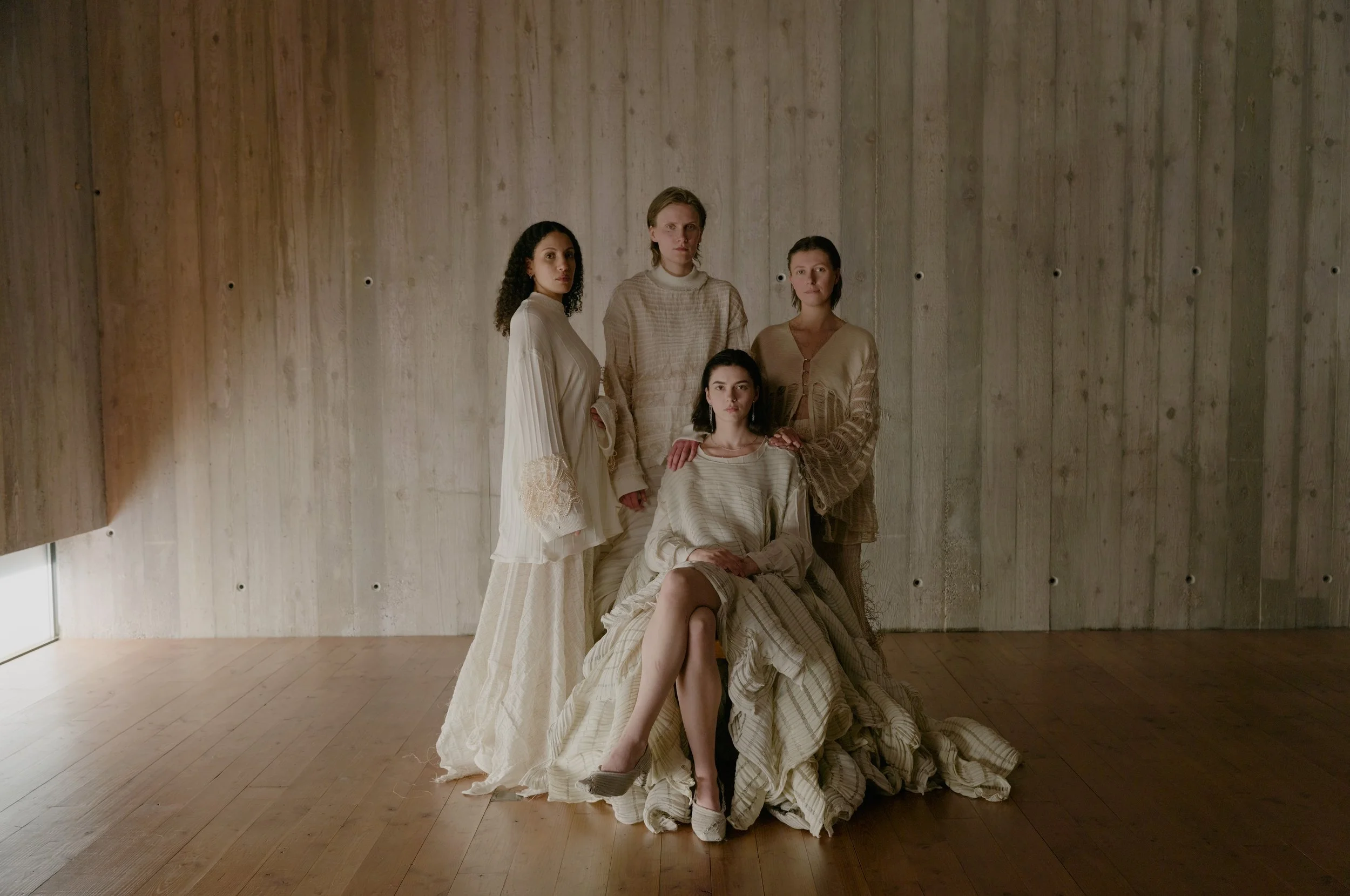
Photography by Benedikt Adler
Could you please introduce yourself?
I’m a Finnish fashion and textile designer who graduated from Aalto University in Helsinki in 2024. My work focuses on experimental and sculptural knitwear, combining traditional craftsmanship with unconventional knitting techniques.
I approach knitting as a form of artistic expression, much like painting or sculpture. Rather than following predetermined patterns, I let the material and the making process guide the final form. I have developed my own way of knitting in multiple directions, creating three-dimensional structures that are difficult to reproduce.
Alongside fashion design, I have studied politics and communication at the University of Helsinki. This has influenced the way I think about fashion and its relationship with society. I see fashion as an art form, but also as an industry with significant environmental and social consequences. My work challenges the idea that clothing must be designed for mass production and continuous consumption.
Having graduated recently, how do you look back on your studies?
My studies at Aalto shaped both my artistic thinking and my identity as a designer. I had the opportunity to experiment with many different techniques, including dyeing, sewing, weaving and knitting. This gave me a broad understanding of materials and craftsmanship, and eventually helped me discover that knitting was the technique I wanted to focus on.
I also had considerable freedom to explore my own ideas. During my studies, I spent a lot of time searching for my artistic identity and questioning what kind of designer I wanted to become. It was not always an easy process, but eventually I found my own way of working.
Being surrounded by talented and ambitious people was both inspiring and demanding. The atmosphere pushed me to develop my technical skills and artistic expression. Looking back, the most important thing I gained was the confidence to trust my own ideas and work more independently.
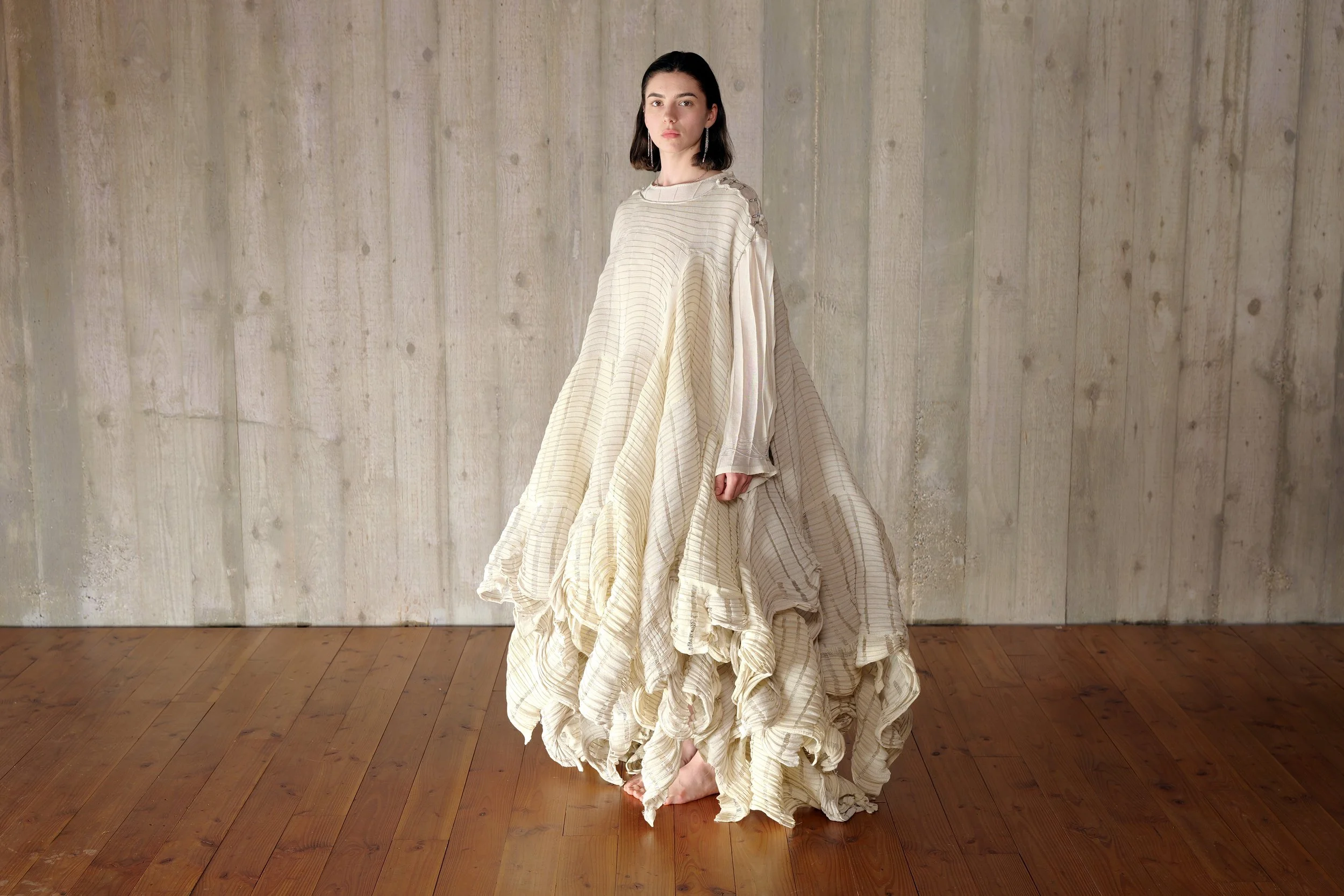
Photography by Benedikt Adler
Could you please tell us something about your graduation collection/project?
My inspiration for creating graduation collection is based on my ancestors' correspondence from the early 1900s in Finland and China. In 2018, I received a box of letters from my grandmother. These brown, neatly folded letters contain stories spanning about a hundred years, with various recipients and writers. Together, they form an intriguing picture of my family's dramatic life around the world.
My great-great-great-grandfather, Hannes Sjöblom, was Finland's first missionary to China in the early 1900s. He fell in love with China at first sight and wrote in a letter in 1901: "The journey from Shanghai to here (Hankou) took four days. During this time, our love for this country, and for these people, who swarm around us like ants, has grown. Seeing the well-tended green fields along the majestic Yangtze River, one couldn't help but exclaim: oh, what a magnificent country!"
Hannes took stunning photos of China, which are preserved in Finland's National Archives. These photos are the inspiration for my work, in particular, the photos featuring the sails of Chinese ships. The white sails, with their straight wooden masts, holes, and wear, are echoed in my pieces through the use of paper yarn and white cotton yarn. Additionally, I mimic the letters' unique characteristics in my work. From the marks of time such as stains, sun fading, ink yellowing, and the fragile condition of the paper, to the contents of the letters themselves.
Which materials, techniques, programmes and/or applications are you mostly interested in?
I’m particularly interested in natural materials and knitting in all its different forms. I enjoy working with wool, cotton and more unconventional materials such as paper yarn. Natural fibres often have qualities that I value: they feel pleasant to work with, breathe well and have interesting textures and properties.
Knitting fascinates me because of its almost endless possibilities. I find it rewarding to concentrate on one technique and continuously discover new things it can do. Even small changes in yarn, tension or stitch structure can completely transform the appearance and behaviour of a textile. I also appreciate the practical qualities of knitted structures. They are elastic, can be repaired and naturally adapt to the body.
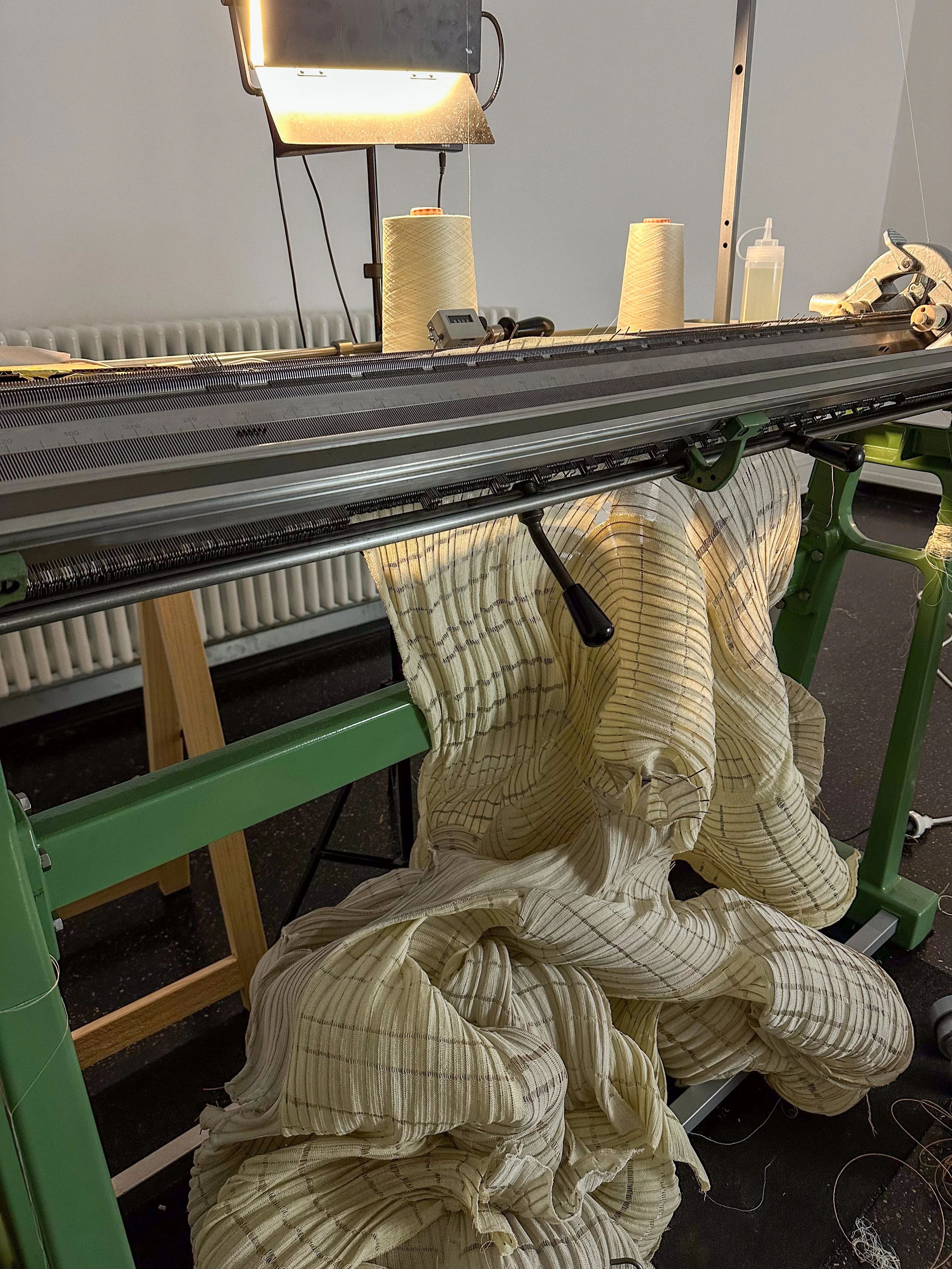
I mainly work with old mechanical knitting machines, which allow me to control the material directly and develop my pieces intuitively. The combination of technical knowledge and creative freedom is what makes knitting so interesting to me.
The exhibition you are part of looks into the connection between animals, people and place (Flock, Folk, Field). What does this mean to you, and how do you see it reflected in your work?
For me, the exhibition raises important questions about where materials come from, how they are produced and the relationship between craftsmanship and the natural world.
I enjoy working with old mechanical knitting machines because the process is slow, physical and very hands-on. Craftsmanship does not feel nostalgic to me. It is simply the way I prefer to work. It allows me to make decisions directly at the machine and create pieces that depend on time, skill and experimentation rather than standardised production.
Wool is a particularly valuable and inspiring material to me. Its natural elasticity allows me to create flexible, three-dimensional knitted structures, and the way the material behaves directly affects the shape and appearance of each piece.
Working with natural fibres also makes me think about their origins. A natural fibre is not automatically an ethical one. Animal welfare and traceability matter, and both can be difficult to verify when materials move through long international supply chains.
To me, craftsmanship and responsible material sourcing belong together. Understanding a material means understanding not only how to work with it, but also where it comes from and what its production involves, and hopefully the European Digital Product Passport will help both designers and consumers trace the origins of materials in the future.
How do you perceive the meaning and importance of community within the fashion field?
I think community is an essential part of all creative work. Other people challenge your thinking, introduce new perspectives and encourage you to explore ideas you might not have considered on your own.
A creative community also provides emotional support. Artistic work can be demanding and sometimes quite lonely, especially when you spend long periods working independently. Having people around who understand these experiences makes a real difference.
However, I don’t think the fashion community should be limited to people working in fashion. Some of the most interesting ideas and collaborations emerge from encounters between different artistic disciplines.
Musicians, painters, photographers, dancers, performance artists, designers and people working with light or sound can all be part of the same creative community. We may use different tools and methods, but many of our interests and questions are shared.
For me, the value of community lies in this exchange of ideas, knowledge and experiences, rather than in belonging to one particular field.
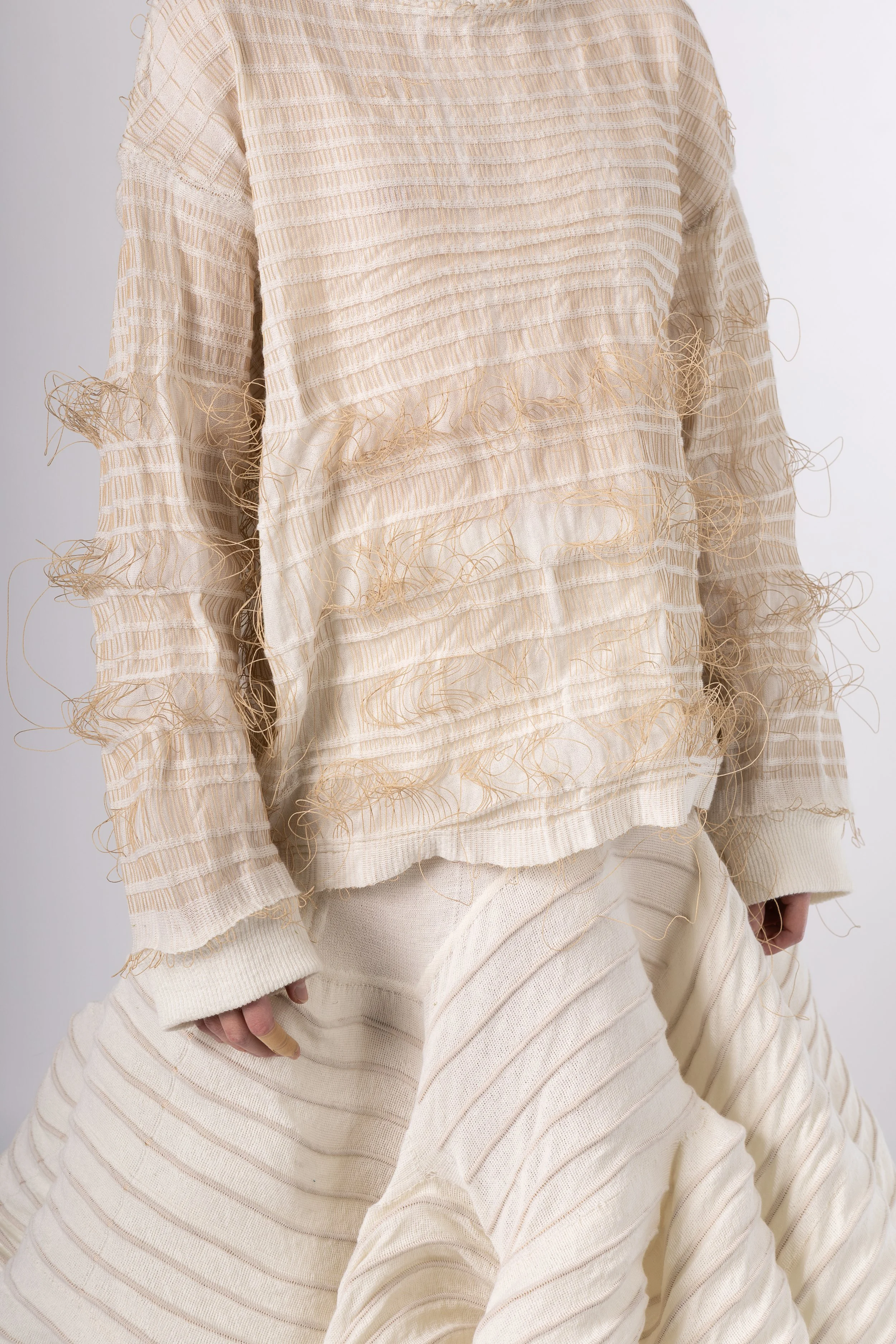
Photography by Benedikt Adler
How do you view the future of fashion? And your own role therein?
I think fashion will have to change considerably in the coming decades. The current levels of production and consumption are not environmentally sustainable, and the industry cannot continue to rely on the exploitation of people, animals and natural resources.
I believe we need to move towards consuming less and taking better care of what we already own. In the future, I hope everyday clothing will increasingly consist of well-made, durable pieces that people value, maintain and repair rather than constantly replace.
At the same time, I think fashion will continue to have an important role as a form of artistic expression. However, I can imagine a future where highly expressive and experimental fashion becomes less connected to everyday consumption and more closely associated with art, performance and special occasions.
I see my own future within artistic and creative communities, continuing to explore the possibilities of knitting and textile art. I’m also interested in expanding my work beyond clothing into sculptural textiles and interior design.
My ambition is to develop a practice where craftsmanship, artistic freedom and responsible production can coexist. I want to create pieces that have lasting value, whether they are worn on the body, placed in an interior or experienced as works of art.