
Talent Talk: Kristrún Rut Hassing Antonsdótti
Kristrún Rut Hassing Antonsdóttir’s graduation work occupies a space between the organic and the strange, where ancient stories, natural materials and instinctive making come together. She explores ways of embedding Icelandic folklore, landscape and traditional craft into her textile practice, creating a dialogue that invites a closer consideration of craftsmanship and the inherent value of materials.

Photography by Sigurður Erik
Could you please introduce yourself?
My name is Kristrún Rut Hassing Antonsdóttir and I’m a newly graduated fashion designer with a BA from IUA in Iceland. My personal focus is on textile and surface design. Moreover, my main focus is on hand-knitting, crocheting, felting, spinning and working with thread. I’ve worked a lot with natural materials where I’ve gained experience in wool and leather.
Sustainable practice and using natural materials is of utmost importance to me as I believe that it contains energy that helps me connect to the natural creative flow it holds, making the process more personal. I thrive where I’m able to work straight with the raw material, letting unconventionality blossom by giving it space and time. I work to create irregular patterns through combining different shapes made by relying on technique, natural flow and feeling.
Having graduated recently, how do you look back on your studies?
These 3 years at IUA greatly developed my knowledge and shaped me and my identity as a designer. Looking back on my studies I realise how much time and space I got to develop and experiment with natural materials, sustainability and garment construction. Throughout my studies I stayed within textile and surface design, but experimented with different directions within that field which allowed me to gradually drift towards what really drives me as a designer. In the last year, I got to fully work with designing unconventional textile while combining it with natural materials and working with threads which is eventually what I’m still interested in pursuing after having graduated.

Photography by Sigurður Erik
Could you please tell us something about your graduation collection/project?
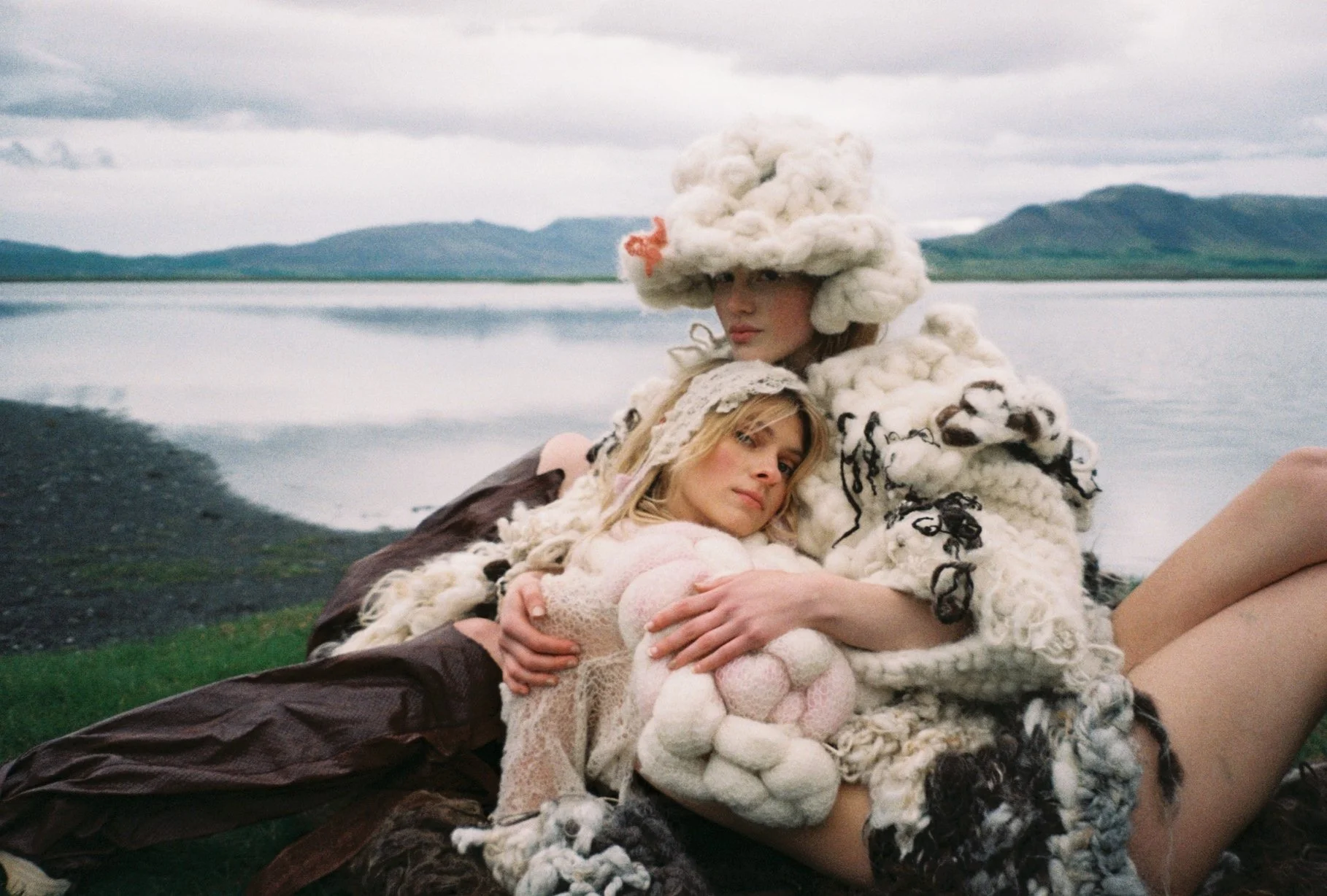
The BA collection, Left behind is a rock in a strange place… is inspired by the folklore tales of Icelandic night-trolls where I studied their outlook, clothing and social standing, but most importantly, looked at and focused on their transformation. The transformation of Icelandic night-trolls takes place when sunlight hits their skin, turning them into stone. Moreover, the collection explores material and visual opposites rooted and formed within this transformation. Emphasis was put on textile development and working with natural materials like wool, fish leather and stones. On the contrary, materials like wire thread and clay came in as unconventional materials and metaphor for structure and sculpture. There’s an immense focus on Icelandic wool where I explored working with the transformational elements of raw wool, seeing and constructing transformation within the tiniest details. Crafting the material helped me connect and understand the rich history of craftsmanship while also making it possible for me to develop unconventional ways of sculpting each garment without a pattern. The fish leather is an Icelandic by-product and used in its natural state where nothing was cut off, but sculpted and draped onto the body where its irregularity and simple patterns of old Icelandic clothing are combined. Working with stories integrated into Icelandic landscape that I remember hearing when I was a child created a sense of heritage and romantic outlook seen in the texture, delicate knitting and sculptural elements.
Which materials, techniques, programmes and/or applications are you mostly interested in?
As I mentioned earlier, I thrive when I’m able to work with the material by hand and get the feel of creative freedom where I’m not trying to shape the textile to my will but creating movement within the beauty of defaults. Almost all of the textile in the BA collection was handmade and draped in parts, either knitted or crocheted. The fishleather was a surprising new material that I enjoyed getting to work with and will further integrate into my practice. I’ve been overly obsessed with raw wool or reifi, as we call it in Iceland, which is unprocessed wool straight from the sheep. However, I’m equally as obsessed with wool in each of its states: raw, felted, combed, spun, knitted, weaved, crocheted etc. During the creation of my BA collection I learned how to spin wool both by hand on a spinning needle as well as a spinning wheel. Spinning as a method is something I’ll be further exploring, as well as working with natural materials like raw wool. Lastly, irregular ‘lace like’ knitting or crocheting with a single ply lambswool band is also a technique I developed during the creation of the collection and I absolutely found my identity within it.

Photography by Sigurður Erik
The exhibition you are a part of looks into the connection between animals, people, and place (flock, folk, field). What does this mean to you and how do you see it reflected in your work?
Craftsmanship and the ways in which we create and develop the designs is something I’m interested in gaining a more in-depth knowledge on. Being able to craft the material in ways most people don’t understand opens up great possibilities of expanding the creative practice. This connection to not only the material, but our surroundings and the people behind the work deepens not only our understanding of the value of each product, but also strengthens its story. Working with raw wool has transformed the way I look at it, as I see each sheep's story and character being reflected not only in the colour combination and lock length, but also in the feel of its texture and how I’m able to work with it. Understanding the process and the work behind craftsmanship creates a sustainable way of looking at all things being created and used in our everyday life.
How do you perceive the meaning and importance of community within the fashion field?
Last summer I participated in a RANNÍS funded research project where I studied the historical and social aspect of hand-knitting in Iceland. I got to step into a world where heritage, value, and a tight knitted community is at forefront and tells a very special story, which is similar to the values of my practice and the rich history visually felt in detailed and handmade designs. Connecting with people and professionals within the varying fields of fashion helps preserve practices of craftsmanship and enriches each practice’s heritage and ongoing story.
Photography by Sigurður Erik
How do you view the future of fashion? And your own role therein?
I hope to see the process of creation slowing down as we start to further understand the quality within each piece we create, buy, and put in our surroundings. Every piece of textile and its material quality makes a difference when it comes to longevity, repair and sustainability. Awareness of natural materials and their increased role in creating a more sustainable market is rising and I hope to see not only fashion but also consumers choosing to connect with the process behind well crafted design. Furthermore, understanding and creating a relationship with our garments and their role in our life will greatly increase their longevity while also slowing down the need for consumption. I hope to have my practice serve as an example of quality and sustainability where materials are explored and people get to see the value within natural materials. Moreover, as I keep connecting with the hand during the creative process I hope to reflect value on Iceland’s rich history of working with thread while honouring our most understated treasure, the Icelandic sheep.