
Talent Talks: Esther de Groot
Photography: Bart Hess
Esther de Groot is a Dutch artist whose work is characterised by an expressive visual language that is reflected through the intertwining of different fields as graphic design, illustration and textile sculpture.
Carried out in different forms, a recurring theme in her work is the role of the individual in connection to the practice of ‘keeping up appearances’ and the performative aspects of life. The concept of ‘otherness’ in relation to masquerade and performance can be seen as the key concepts to her artistic practice and research related to textile craft.
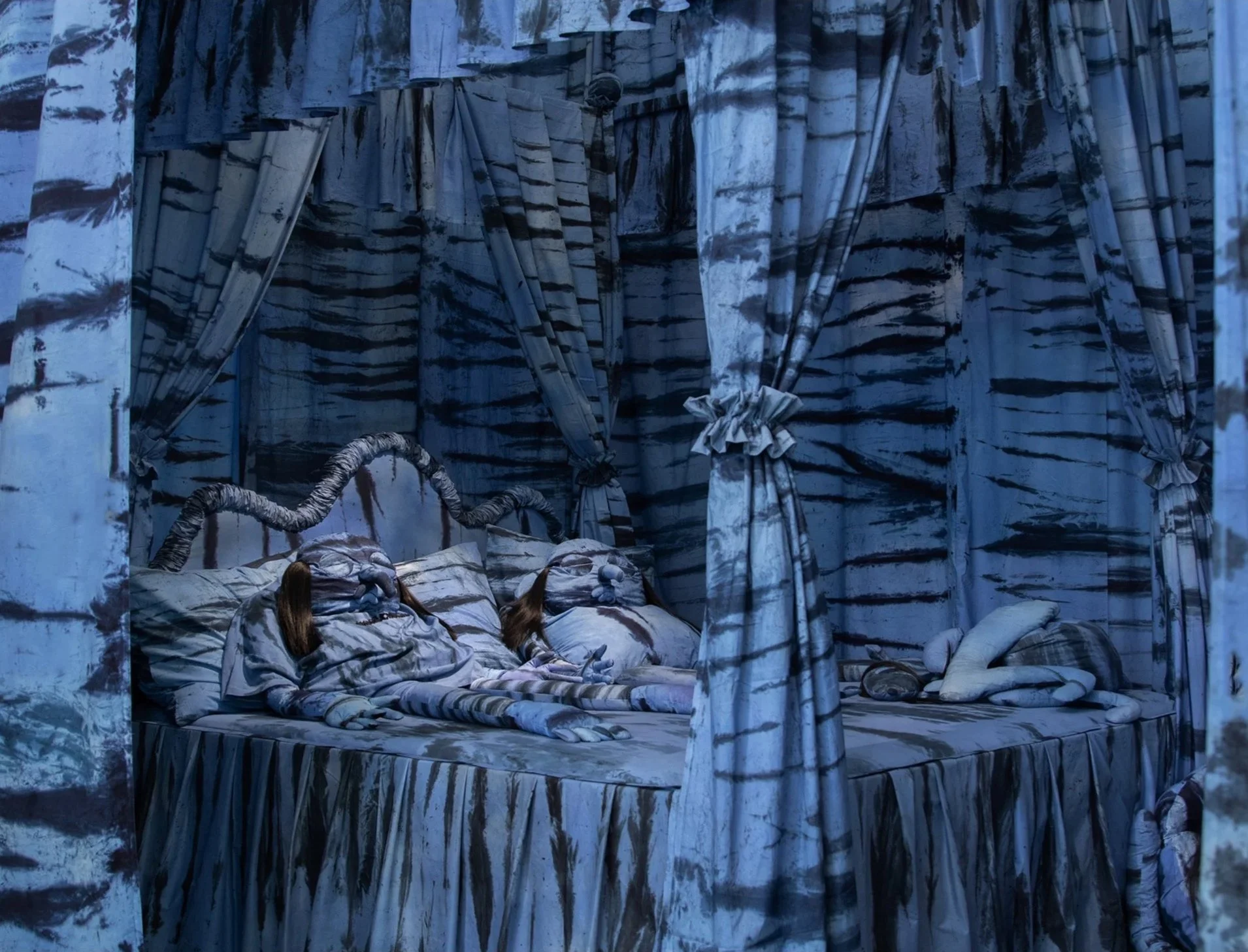
We sat down with her to learn more about her new work and exhibition ‘La Chambre Bleue.’
We've known you at NOOF for quite some time now, but for those who might not know your work yet, could you introduce yourself and tell us a bit about what you do?
Carried out in different forms, a recurring theme in my work is the role of the individual in connection to the practice of 'keeping up appearances' and the performative aspects of life. The concept of otherness in relation to masquerade and performance can be seen as the key concepts to my artistic practice and research related to textile craft. The past ten years the focus of my practice has moved more and more to the textile dimension, while making use of my background in Graphic Design and Illustration. My aim is to view craft as a relevant method for questioning and challenging the time in which we live and as a tool for critical investigation through making and materialisation.
La Chambre Bleue creates a very distinct atmosphere and visual language. Could you tell us a bit about the story or ideas behind the work? What inspired the installation, and where did the initial idea come from?
For long now, I’ve had a fascination for human- and animal representations throughout the history of visual and narrative communication. I am not primarily interested in classic or realistic representations but even more so in hybrid, anthropomorphic phenomena and traditional, non-Western representations imbued with symbolism and metaphors. The main focus of my research lies in the field of ancient folklore crafts and traditions related to
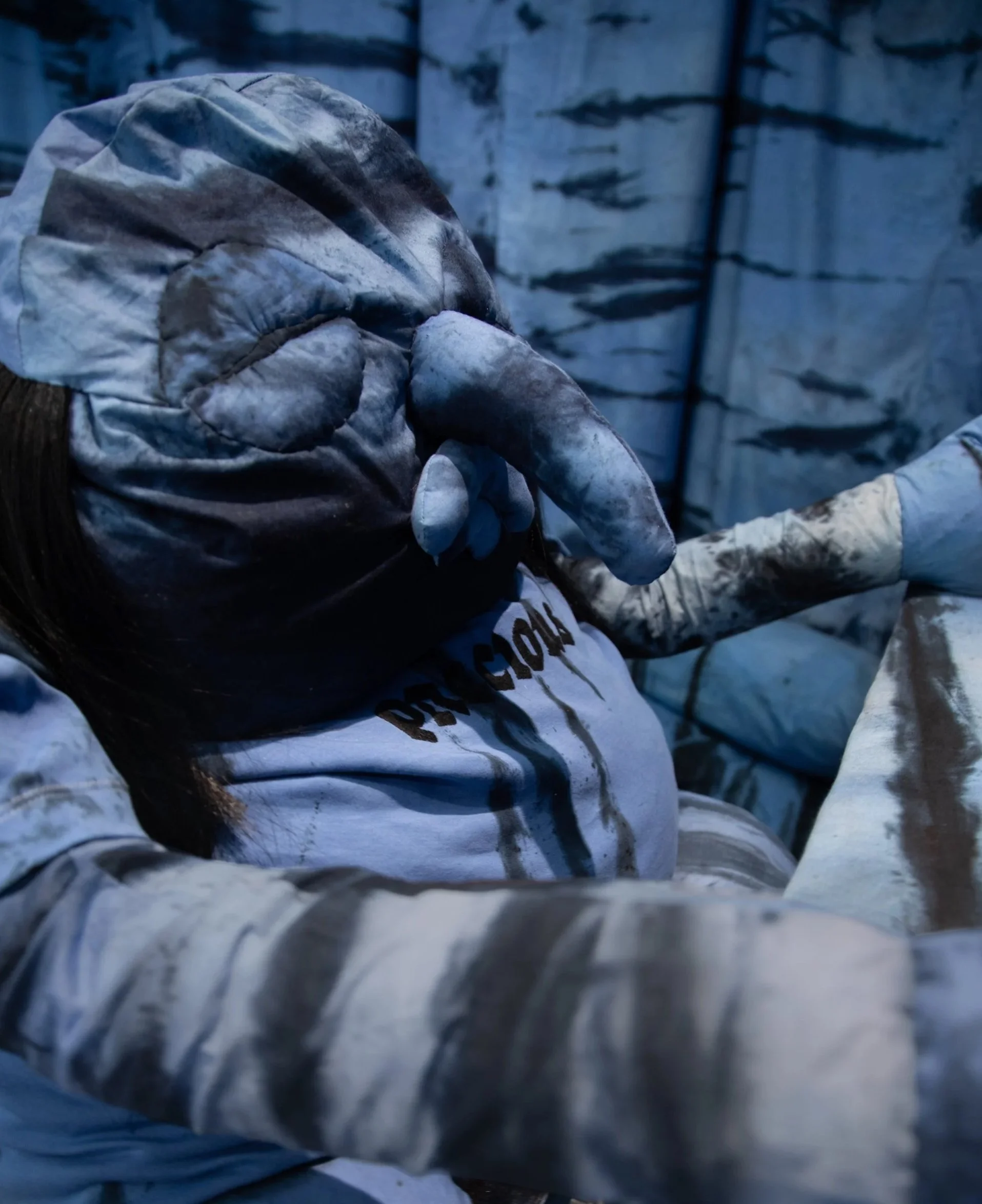
masquerade rituals. During my Master in Stockholm researched the ambivalent qualities of the mask and for my, 1-year, Post-Master Programme, I did (practical) research on the subject of ‘otherness’. During this year I started the project “Salon the Refusés’, which resulted in a series of hand screen printed textile figures. I had bigger plans, as the name of the project might suggest, that were just not feasible due to the relatively short duration of the program. When the opportunity arose to do something with the textiles I had dyed the previous year for NOOF's exhibition during the DDW, I knew immediately that I wanted to give 'Salon des Refusés' a sequel. That is how "La Chambre Bleue" came into being.
Photography: Bart Hess
Every creative practitioner approaches making differently. What does your creative process typically look like, from the first spark of an idea to the final outcome?
My practice is very process-led and emerges out of research in the form of repetitive processes and experiments through materials. I do a lot of research and gather information. Next, I open a document in which I note down loose ideas, sentences, quotes, and references. I make connections and create a kind of framework for myself in my head. I start the creative process quite intuitively, with all this information in the back of my mind. During this phase, I often struggle to get going and frequently doubt my ideas. Eventually, I make some rough sketches and just start making. Subsequently, my ideas take their final form during the making process, also simply through trial and error.
Textile printing plays a central role in your work. Could you tell us a bit about the techniques and processes behind this installation?
For this installation I repurposed the hand-dyed textiles made for, and commissioned by, New Order Of Fashion for Dutch Design Week 2024. Where I usually work with screen printed textiles, I was asked to hand dye 800 meters of textile in four different designs and colour ways. The process was quite intuitive. I did some research into dyeing techniques and spent an afternoon visiting Karin Waag and René van Eersel, prominent botanical dyeing experts and mentors associated with the NOOF LAB. This was very helpful. After I made four different designs, I started testing on a small scale. This is obviously not comparable to dyeing on a large scale, but it is a good starting point to understand how different materials and techniques work. Next, I got to work on a large scale. In this case, that was a huge logistical challenge due to the enormous quantities of fabric. For the blue print used in the installation, we made wooden working molds/templates during the process that made it easier to achieve the desired print.
Textile printing continues to evolve through new technologies, materials, and ways of working. How do you see the future of textile printing developing towards a more regenerative future?
In essence, textile printing is a fairly polluting technique, primarily due to immense water consumption, energy use, and toxic chemical runoff. Fortunately, there are positive developments in this area. Digital textile printing is a more sustainable option, although I do not (yet) use this technique in my own practice, I do create digital prints for artists like Bas Kosters, and the results are absolutely visually satisfying. However, not every design is suitable for digital techniques. Fortunately, there are many developments in the field of dyeing with natural dyes, and there is growing interest from the creative sector. Initiatives like NOOF's Manus x Machina program, where botanical dyeing experts Karin Waag and René van Eersel collaborate with the New Order of Fashion lab and grow their own dye plants, teach pigment extraction, and mentor emerging designers to champion sustainable, chemical-free textile practices are promising and interesting developments.
During the exhibition period, you also facilitated a workshop at NOOF. Was there anything that surprised or inspired you through the interactions with participants?
I’m always surprised, yet not surprised, how we can be stuck in a certain thought pattern. For the workshop I asked the participants to translate some of their most outspoken personal traits into physical characteristics of an Alter ego. We appear to be inclined to make fairly literal translations and find it difficult to think more figuratively. Ultimately, it is inspiring to see that everyone, despite struggling with it, has their own way of solving their difficulties, resulting in very different and incredibly 'personal' alter egos.
The installation has now been experienced by visitors for some time. Looking back, how do you reflect on the work and the responses it has received?
I am very happy with the work, however I’m already thinking of ways to improve the installation. But since I’ve used every last centimeter of available textile, it might require some more dyeing first. I am not particularly interested in a certain response from people who visit the exhibition. The aim is to create a world or environment that leaves room for interpretation. I want to provide just enough information to give context but like for people to experience the installation the way they do. If it brings a smile to their face that is a plus.